Wednesday, 1 August 2012

Just what is technology?


The abstract concept of technology covers quite a lot of ground, Agriculture-industrial or organic, industrial arts- blacksmithing, factories and modern high tech, energy collection to energy use and every form of transport except walking. A useful phrase is ‘technology only uses energy and matter, it cannot create them’. While this is entirely accurate, another phrase has to be added, “Technology is also the primary means by which humans make energy and matter usable’. For oil to be usable, it first must be dug up, even if by shovels powered by workers feed by small-scale farming, and then refined. All but the most primitive hunting techniques, like utilizing our natural endurance to run down animals, require tools and while gathering can be done without them it is greatly improved by baskets. So technology can be divided into collectors (agriculture, mining etc) and utilizers. But there is also another dividing line, that between human driven (tools, bikes, etc) and non-human driven (sailing ships, computers etc). Both of these form a spectrum since no action can be done without energy and matter but large parts of our tech base is simply making energy or matter usable, metal refining is both a collector (refined metals) but also a utilizer (ores, heat energy). Moreover, to a certain extent, human driven technology can be swapped for non-human technology and vice-versa e.g. pumping can be done by both windmills and human effort.

So when we speak about it, just what is technology?     

Parochialism – or a return to small-scale thinking


E.F Schumacher wrote ‘for his different purposes man needs many structures, both small ones and large ones, some exclusive and some comprehensive.’ He was mainly talking in the realm of economics, business and politics but after reading Lewis Munford’s technics and civilisation, I have begun to think that we should begin listening to his advice in the realm of thought and ideology.

I have noticed that people more often than not think of solutions or values in a large thought, say a global scale (we can save the world) or national level, instead of the smaller scale of regional, local or personal level. However, a lot of effective action comes from the smaller level and the changes in peak oil will affect us at every scale. The good news is that parochialism, regionalism and localism are already returning into the realm of thought and a lot of writers on overshoot (Dimitri Orlov, John Michael Greer, Sharon Astyk etc) are already ahead of the curve with responses for individuals or communities and ways of thinking.

an old project


this is a school project i did last year that is relavent, this was before i was peak oil aware, was written a day or two (i fixed some of the writing errors) before it was due and a lot of the data comes from wikipedia. it is not my current views or what i would write now but is what i picked up by just living in the mainstream.
Ecological Issue                                                  Leo Santilli
                                           Competing Agricultural Systems
Two major changes to humanity happened in the last five hundred years. The first of them, the scientific revolution fundamentally changed the way humans both thought of the world and interactions with it. The adjustment to a theory and experiment based knowledge system instead of a religious and superstitious one allowed major advancements to occur, such as Andreas Vesalius's De humani corporis fabrica (on the fabric of the human body) or Carl Linnaeus classification system, in rapid succession and with an understanding of the reasons behind them in an objective and testable way.
One of the biggest effects of this earlier revolution was the later industrial revolution, which allowed the changes of the scientific revolution to begin affecting the majority of humankind on a large scale due to the application of scientific analysis and knowledge on mechanics (steam engines, ships, looms etc). The addition of machines that didn’t rely on human muscle power alone greatly increased the productivity of workers in both the extraction (farming, forestry, etc) and manufacturing industry.
The change to agriculture due to both the scientific and industrial revolution is not complete as two main systems are currently competing. The industrial based Green Revolution (or industrial agriculture) and the reactionary organic movement in an attempt to provide the world’s population with a stable secure and balanced (non-nutrient deficient) food supply.

The Green revolution came out of the industrialisation of agriculture for example. Monocultures, a staple of the conventional modern farm, where large areas are used to grow only a single variety of crop due to standardizations efficiency. Potatoes, for example, in use outside of their point of origin, South America, tend to be chemically similar and similarly shaped to make machine processing as efficient as possible. This has the unfortunate side effect of increased disease prevalence due to the lack of diversity that species use as a natural defence (community immunity). This problem is solved via the application of pesticides, herbicides and fungicides, normally chemicals produced industrially for use across large areas.
One of the biggest innovations is the development of High Yield Varieties. HYV can easily outcompete traditional crops when given proper irrigation, nutrients and protection from harmful organisms. All of these things can easily be provided by the associated system of the Green Revolution. Nutrients can be artificially obtained, like nitrogen from the Haber - Bosch process, and applied to crops, one-half of nitrogen in humans is now artificially supplied. Various new types of irrigation such as drip feed or improvements on old techniques, enclosed plastic pipes and pumps, allow easy access to water. Without this additional infrastructure HYVs perform poorly however. 
Unfortunately, this type of agriculture results in a complete change to the biosphere it’s located in and the simplistic corrections made to the crops soil (adding fertilizer in bulk, mass spraying pesticides) favoured by a industrial approach, mass application of simple solutions is efficient with mass production and centralised control systems, can have undesirable consequences on other parts of the biosphere and it relies on the whole system being intact and functioning.

The organic movement on the other hand is the changing of the traditional farming methods practiced for thousands of years to use modern knowledge and understanding to provide an independent system, generally bottom up in structure, using natural and organic processes as opposed to inorganic methods to solve problems within the system.
For example, instead of using nitrogen fertilizer made by the Haber - Bosch process rotate legumes intro the field next growing season or increasing disease resistance by practicing crop rotation to stop build up of soil pathogens. Organic farming is also built more on producing systems to maintain the environment necessary for farming rather than relying on external solutions e.g. providing a habitat for a predatory insect species to keep harmful pests down instead of applying pesticides when a problem occurs.
The main benefits of organic farming is the reduction of environmental damage that has come about by industrial farming and the use of scientific knowledge to build efficient systems using natural occurring processes in a way previously impossible in any reasonable time frame (it took the new guineas until recent times to adopt the silviculture of Casuarina oligodon over the entire island after its cultivation began in 1200). And an understanding of the consequences of their practices in the future to avoid later problems.
The downside of organic farming is the intensive labor requirements needed and that it is only practicable in already fertile regions, e.g. the Western Australian wheat belt must have all nutrients added artificially due to the complete lack of soil fertility of the region. The knowledge base also needs to be quite high since simplistic solutions cannot be used as they are in industrial farming.
The amount of land used can be lower than in industrial farming, especially in the first world, for the same output, which in itself is the most destructive use of farming.

The main consideration when choosing the different agricultural methods is the long-term food security they provide for expected population levels. I.e. slash and burn is fine at low densities but suicidal at high densities.
The main problem regarding the industrial method is that it requires a supporting infrastructure, technology and scientific infrastructure unavailable to the majority of the world without being imported. Also, its best success has been in Eurasia and America which have very different geographic structures (central continental axis is east to west) and thus climates than Africa and South America. While in Africa and New Guinea organic farming methods have had great success in increasing yields.
Organic farming is the most sustainable in the long run for both soil fertility and surrounding ecosystems that support farming in various ways. However, the use of artificial fertilizers and pesticides can be beneficial while avoiding the majority of side effects if used in correct quantities and at the right time, simply dumping it on creates the majority of problems. The scientific method would provide the best solution for finding the right mix of techniques but to solve the problem a change in how farming is done needs to be implemented. All aspects need to be considered instead of the single ones people normally choose e.g. only yields, costs or environmental damage and no single approach should be used to provide redundancy and account for regional variations in infrastructure and climate. Where industrial farming works well needs to be kept since the higher yields will allow continued food supply once the third and second worlds population explosion starts big time, especially with aquaculture due to the majority of fish stocks having crashed or likely to in the near future.

Bibliography:
BBC: Discovery - Can Chemistry Save The World? (Not sure what episode)
Igbozurike, U.M. (1978). "Polyculture and monoculture: contrast and analysis". GeoJournal 2 (5): 443–49.
http://www.cropscience.org.au/icsc2004/symposia/2/1/1128_cookrj.htm
http://www.ifoam.org/growing_organic/definitions/doa/index.html
Wikipedia
Collapse by Jared Diamond
 Germs guns and steel by Jared Diamond
http://journals.cambridge.org/action/displayAbstract?fromPage=online&aid=1091304
http://www.salon.com/technology/how_the_world_works/2006/12/11/borlaug/
http://www.unctad.org/en/docs/ditcted200715_en.pdf

Overshoot


The concept of overshoot is an important one if one wishes to understand the changes that started 300 years ago at the beginning of the industrial revolution and are now entering a turning point that will take us to the next stage of overshoot.
So what is Overshoot?
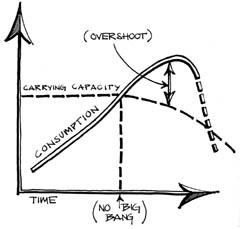
http://www.paulchefurka.ca/Overshoot.JPGOvershoot is a simple concept that is described easily by visuals. See the graph on the right, that is what overshoot looks like, except that the variable is normally population not consumption, and it has two sides one of an expanding and the other contracting but both are the same process. Overshoot is just when consumption goes above the long-term carrying capacity of the ecosystem and it normally keeps on climbing but at the expense of a diminishing carrying capacity. This is okay until the point that carrying capacity can no longer support the population and in response population drops until it reaches carrying capacity that is now only a fraction of what it was before. The upside may look rosy but from the perspective of an individual in the population but once the decline happens, which is inevitable once overshoot has appeared, the previous growth phase is a hindrance that prolongs the length of time until sustainability is reached and reduces the end carrying capacity.

What happens next depends on the exact nature of the carrying capacity in question, the species place in its ecosystem and the ecosystem itself. In the case of the snowshoe hare and lynx, their populations continually cycle up and down. This is characteristic of simpler ecosystems with a small amount of controls on population. In the case of the snowshoe hare there is only the crude mechanism of predator-prey to keep their populations in check and as the graph shows this is not enough. But the north Atlantic Cod decline (due to overfishing), which has permanently reduced the long-term carrying capacity of fishing in that region, is permanent. This was caused by a shift in the Cods ecosystem, the predator prey part, that has lowered the reproductive ability of Cod. The shift was driven by the low cod numbers which allowed their prey to have a population boom, the prey eat cod eggs and young (this is quite common) and now they stop the Cod population from regaining its former levels. The north Atlantic cod fisheries will now never regain their previous level of consumption without another major ecosystem shift, one which would probably do massive harm somewhere else.  
The difference in these cases is a function of the different complexity levels and its effects in their respective ecosystems. In a complex ecosystem, overshoot is less common since more controls are in place and step in more frequently when one or more fail. But as the north Atlantic cod shows these complexities can also enable shifts in an ecosystem to occur when overshoot does happen, such as when allowed by the use of fossil fuels and advanced technology. The world we live in, as befits an entire planet, is incredibly complex and the shifts that will occur will dramatically change humanities position, power and abilities as the multitude of ecosystems we live in change drastically in response to our decline.

We are at or close to the peak in population or consumption levels and it is unlikely that we can hold of the plunge much longer. The way down will be a long, slow and ragged process until we reach our carrying capacity dictated by the planets biosphere and subject to the changes induced by climate change.   

Overview of Australia’s situation


http://www.abc.net.au/reslib/201003/r528358_2985793.jpgAustralia the continent is a vast desert surrounded by fertile land next to the southern and eastern coasts. I’ve travelled to all the capital cities and done the North-South journey so I have a clue about the broad biomes and areas of Australia. The other important fact is the vast distances between points of interest and the isolation this causes. Perth is the most isolated city in the world and the only reason it I part of Australia is our extensive transport system, which is highly dependent on fossil fuels, and our centralized government. The large distances also characterise the position of Australia to other countries, yes, Indonesia and New Guinea are close but only to the relatively unpopulated and sparse northern coast. This forms Australia’s greatest defence, similar to Russia’s winter (think Napoleons invasion), and any invasion or mass migration will have to first overcome this obstacle.

Australia’s resource situation is fairly good on non-agricultural or biological resources (wood, fish etc) with a large amount of natural gas, coal reserves, iron and rare earths such as samarium, cerium or lanthanum. We have good wind power and lots of sun. this puts a theoretical eco-technic (based on renewable) industrial complex based on windmills and solar furnaces that could be worked into a sustainable economy, hydropower is also available in some spots for either electricty or mechanical energy generation at various scales. Coupling with a sustainable agriculture, possibly based on Permaculture, would allow a fairly stable and relatively high tech society to exist. We also contain a world class education system, that’s main deficit is the current slashing of TAFE (vocational education), and Permaculture was started here, so the necessary human skills could be created and maintained.

Our current governmental system is built around three levels; local, state and federal. Each state is centred on the capital cities of; Brisbane, Sydney, Hobart, Melbourne, Adelaide, Darwin and Perth. Canberra fills more of a federal role as the ACT isn’t very big. Regions have their own centres as well but the main centralisation is around the capital cities. The coastal cities have the best access to transport since most of Australian society is based close to the coast, since the interior is a desert, and as coastal country our dock cities are vital. In the future dividing along city state lines based on the current capital cities would be quite easy and if the situation demands it quite an adaptable choice.

Australia is a vast continent with plenty of mineral, energy and the human skills necessary for an economic restructuring, voluntarily or not. Agricultural resources are adequate and despite the wishes of our government and major agro businesses we won’t be able to become the ‘bread basket of Asia’, this is probably for the best. And our governmental system’s are fairly resilient with the next step down into city states already set up and prepared to go. Our isolation will affect everything and will both help, in the case of invasions or mass migrations, and hinder, in the case of trade. These are the basics of Australia’s situation    

a potential future


A Potential Future
The effects of Catabolic Collapse on Australia and how Australian policies can affect the outcome.
        History has cycles; an important one is the rise and falls of the civilizations such as the Romans, Mayans or Easter Islanders. Today’s Global Industrial Civilisation (Global civilisation) which had its beginnings in the industrial revolution of Europe, spread to the rest of the world during European colonization of Australia, Africa, Asia and the Americas. With the advance of globalization into all aspects of trade, culture and communication, it has reached the zenith of its power. For every rise, there is a fall. History’s wheel is now turning and Australia’s society will revolve with it. The collapse of a complex civilisation, such as ours is not a simple process. Many thinkers have tried to model collapse, defined here as a large drop in resource usage and social complexity, eg. Joseph Tainter proposed a model that said that a society collapses when it becomes too complex and is no longer able to support itself with a diminishing resource base. Jared Diamond’s model for the collapse of a society is based on the accumulating degradation of the society’s environment to such a point that the resource base is exhausted. These are not mutually exclusive models and I believe that John Michael Greer’s theory of Catabolic collapse, which shares many similarities with the models of Jared Diamond and Joseph Tainter will provide a more accurate model of the collapse of the Global Industrial civilization.

An overview of Catabolic Collapse      
       
      Catabolic collapse is a stair-step down process as periods of collapse are interspersed with periods of recovery and stability until a much lower, stable, equilibrium point is reached. the four variables of the catabolic collapse model are: resources, capital, production and waste. Resources are the naturally occuring factors of the enviroment available to a society. they include such diverse things as unused labour, undiscovered scientific advances, metal ores, trees or soil fertility. Capital is all the factors incorporated into a society's flow of energy, matter and information; this includes tools, skilled labour, market systems or technical skills. Waste is all the factors that have been rendered useless by time or use, this includes ; pollution, retired workers, garbled information or excessive bureaucracy and drains capital. Production is the creation of new capital from resources and capital to either maintain or grow levels of capital. Production depends on both resources and capital, which are interchangeable but at diminishing rates. For the global civilisation, the major forms of Waste are global warming and destruction of the environment (during the extraction of resources) while depletion of resources includes loss of soil fertility, rare earth shortages, depletion of fossil fuels and, fitting with Joseph Tainter’s model, the diminishing returns of scientific research. In creating his theory of evolution-one of the most important discoveries of man- Darwin’s major tool was observation. Today, however, major scientific advances rely on expensive equipment like the Large Hadron Collider. This shows that science has begun to run into the law of diminishing returns. Catabolic collapse is calculated to occur when maintenance can no longer keep existing capital levels and in response, capital levels drop in society. Simply put, once production levels drop due to lack of resources, capital levels drop also reducing production levels until responses by the affected society solve the short-term crisis. The dividing of the Roman Empire into the Eastern and Western Roman Empires in CE 395 is a good example of this collapse and response model. The Eastern half of the empire produced most of the wealth but had only 1/3 of the border of the whole Roman Empire. Splitting allowed the Eastern Empire to stabilize; however, the collapse continued, creating a pattern of crises punctuated by periods of stability and recovery because the underlining problem of unsustainability was not resolved. 

     Barring an unpredictable event the Global civilisation will go through catabolic collapse as a result of the exhaustion of vital non-renewable resources e.g. oil, coal, gas etc and the overusage of renewable resources such as fish stocks (North atlantic cod), forests, soil fertility and others

How will catabolic collapse affect Australia?

        Australia is not a single entity, but is made up of various states and territories who themselves are made up of many cities, towns and communities. Australia is not isolated; it is a part of the global civilisation. The Global Civilisation is not a coherent entity, but a collection of highly complex systems, ideologies and at least four core cultures (European, American, Chinese and Indian) that are themselves made up of complex systems and factors. In the Global Civilisation the flow of energy, matter and information is on a global scale, e.g. a pipeline moves oil across continents according to market demand.

       Australia is dependent on the global system for both resources and capital. Catabolic collapse in other areas of the world will affect Australia. When Australia suffers catabolic collapse other countries that are dependent on us for resources suffer, sending waves of damage through the global system that can rebound back on us. Due to the interlinkedness of global society only a small disruption is necessary to start a positive feedback loop that resonates throughout the global civilisation leaving only wreckage in its wake until a response by the global system restore equilibrium.

     One of the most important commodities we derive from the Global civilisation is crude oil, which we then refine into petroleum, and various products. Most of our transport infrastructure is directly dependent on oil and so is the growing, processing and transport of food. Our ability to access electricity is also dependent on oil supplies, since coal-mining equipment is normally oil driven. A prime target for collapse is the global oil markets, which could easily be jeopardised by instability in the Middle East, say by an American war with Iran, or the eventual decline in availability, predicted by the theory of peak oil. Oil is non-renewable so a decline in availability is a certainty. Our access to oil would drop quite rapidly if either scenario occurred. If unprepared, the effects would leave us noticeably poorer than before the collapse, even if we have adapted to a shortage of oil.

     However, Australia also supplies commodities, such as food and minerals, to the rest of the World, so problems here can be magnified. Let us say due to global warming or loss of soil fertility our agriculture’s productivity fell. While it is unlikely that we would starve, we would lose the resources (such as oil) and capital we exchange the food we grow. Currently we export wheat to many countries. If the world supply of wheat were disrupted as the result of our lost agricultural productivity, this would lead to social unrest in some of these countries, some of whom produce oil. This would then cycle back to cause further problems for Australia.

    These are only two components of the many forms collapse could take, the scenario that happen will be far more complex and mixed with other factors, Joseph Tainters diminishing returns of social complexity will almost certainly appear, but the basic shape and effects can be seen. People and nations, such as Australia, are not passive actors in the world, though it can feel like they are passive actors, who are at the mercy of History and Nature’s power but active players who have their own powers, will and desires. While we have to work within the constraints of nature, we have to ability to plan and act for the future.

What can be done to minimise the effects of catabolic collapse?
 
     One of the most powerful tools available to governments is policy. Before we consider what policies would benefit Australia an important point must be stressed, Collapse is a reduction in resources availability and our collapse due to lowered resource levels is inevitable. What matters is how the collapse affects our society. The spectrum of policies that can help Australia prepare for catabolic collapse and allow it to thrive during the collapse include; food policy, trade, taxation, industry, subsidies and energy. As such the most useful polices are those that reduce energy and material usage
  • Primarily energy conservation.
  • Decreasing reliance on oil in transport and food production.
  • Shift to a cradle-to-cradle manufacturing system.
  •  Stabilising population levels.

    Changing the context in which everything else functions will also aid the situation immeasurably. An example is taxation. As the economist, Herman Daly (CASSE) said ‘we want to tax what we don’t want or wish to minimise’, the idea behind the Mining and Carbon tax is a good example of this approach. We want to minimise pollution and resource extraction, but this policy needs to be expanded to include more tariffs and trade barriers to compensate for the increased price of resources and manufacturing while still achieving the goals of self-sufficiency. This approach, coupled with a reduction in income tax among the lower income earners, increased grants to help business and industry adapt to the changes caused by this policy, would help Australia prepare for catabolic collapse. Added benefits would be increased wealth equality and increased independence from the global political and economic system.

    As the Global Financial Crisis shows, the financial system needs to be reformed. This vital system has been allowed to grow brittle and too pervasive in our civilisation. Various reforms have been expounded on by Centre for the Advancement of the Steady State Economy (CASSE) and include;
  • A gradual increase to 100% in the reserve requirement of banks to increase stability.
  • Definancialization of core systems such as basic infrastructure and agriculture to reduce the likelihood of systematic shock.
  • Change our financial system from a growth dependent to a steady state model.
  • Implement mechanisms to reduce build up of wealth in the richest portion of Australian society since this takes resources away from the poorer sections.

     If the constraints of catabolic collapse are acknowledged then the challenges catabolic collapse poses are not insurmountable. Today we have a clear sense of history and its cycles and if we decide to listen to history, it will tell us what to expect. The knowledge and scientific advances we have made could allow us to successfully retreat from unsustainability to sustainability without going through major disruptions providing the collective will allow society to use these advances. We could then allow the intellectual and cultural legacy of the last 300 years to survive the coming Dark Age and enrich the societies that will emerge from the wreckage of the collapse of the Global civilisation. As history has shown, the death of a civilisation is also the birth of new one, which shall begin the cycles again. Australians should aim to be survivors of the current cycle and use the changes that will occur to evolve our society instead of revolutionising it. Evolution is a less destructive process and takes into account that human societies are akin to organic entities, they grow and evolve rather than being built and designed and all we can do is direct it and steer it down certain paths.

Initial thoughts on post peak military


Militia
With the expected breakdown of law and order, the economy and central governments the rise of bandits, raiders, low-level warlords and roving bands of warriors (not soldiers) will begin. This return of low and medium intensity warfare into the mainly civilian areas of countries has a few responses. Knights and a feudal system were highly successful, so were their counterparts in Japan, but for a primarily urban population, based in towns or cities there is another good option. Militia that only have to defend the city and the surrounding countryside, have the backing of the concentrated manpower, technical skills and resources of an urban area will be adequate to deal with low-medium intensity threats without needing the level of time and resource inputs of a professional army.  

Land
The primary mode of warfare, Sea and air are ultimately in the service of objectives on land in all but a handful of cases and provide logistical, reconnaissance or protection roles. Land warfare will be changed by peak oil but the question is how? The major components of modern land warfare are the gun, artillery (which is the same basic tech just bigger and slightly altered) and motorised vehicles. The gun is a relatively simple tech that’s been in use for at least 600 years in one form or another and a lot of the advancements aren’t dependent on fossil fuels but precision machining and metallurgy which can be preserved in a post peak world. Artillery, “queen of the battlefield” that is gunpowder based has been around just as long and is certainly possible on a low-tech scale (cannons have been made out of ice and wood). While the tech is slightly different from guns, especially in the modern forms, the principals are the same and the tech base as well. Motorized vehicles, either; transport, tanks or APCs, are different matter since there underlying tech is the combustion engine which is almost entirely fossil fuel dependent. The engines can be run on biofuels and most likely the future analogue of them will be powered by such but that will come with tradeoffs, especially in the world of logistics and the civilian support structure. These components are the ones most likely to suffer, both motorized vehicles and the support structures, and modern armies’ high consumption rate will be a hindrance to its ability to function in a post-peak world. Various solutions such as using bikes, increased train use and reduced consumption of key resources could help mitigate these problems.

Navy
Naval warfare is very different from land and has its own problems and strengths. First, navies are expensive and you get what you pay for, cheap navies are highly ineffective at even pirate hunting and are barely worth the cost. Good navies can be built at a lower resource and tech level but the infrastructure necessary doesn’t exist as now. So what will post-peak navies look like? Two things define naval eras; their weapons (boarding, ram, cannons, turrets, etc) and their main source of motive power (oar, sails or engine). Oars for warships only make sense in close waters, like the Mediterranean (there were oar-powered galleys in the Crimea war). Wind has the advantage of being free, the sails were expensive though, and were still used on the first steam powered warships to give strategic advantages (lower fuel use) so it should steadily become more important. While engines have tactical advantages and aren’t dependent on the vagaries of the wind they will lose prominence due to the increasing need to use biofuels which are expensive, limited and less energy dense. My bet is that engines will stay on coastal ships, think torpedo boats or some classes of destroyers, and potentially the big ships of the line that will come back with the changes in aircraft and missile tech. Weapon systems will most likely shift back to shells delivered by cannons or turret and away from missiles as the needed tech fades away. Metal, or metal clad, hulls will be essential since explosive shells, which are not a fossil fuel dependent technology, because shells shred wooden ships (maybe construction tricks could change that but I apart from cross laminated timber I haven’t heard anything that could potentially do that). 

Air
The only unique form of warfare the industrial age has produced (space warfare hasn’t happened yet) has several pathways available to it. The simplest is that the tech and abilities stop existing completely and in some places this is a certainty especially where its use in warfare is minimal and no domestic use is available. It can also stagnate in its current form; this is unlikely due to the jet engines reliance on high fossil fuel consumption that biofuels won’t be able to substitute. It can regress into a much earlier form, this will certainly happen in some parts of the world and even advancing down other paths will look like this in some way. Lighter than air could quite easily make a comeback in this situation, especially with the decline of missiles, and its advantages will count for quite a lot. The other is alternate forms of air travel that either haven’t been invented yet or have only been tried now, the synergy aircraft project or solar planes for example, and would allow a dynamic airforce. Buts its role and abilities will be diminished and its current status as a separate force will almost certainly disappear and it will become an auxiliary of armies, similar to artillery and other attachments, and for navies, escort carriers or island/shore based. Its role will also change back to mainly reconnaissance with relatively minor transport, attack or defence roles (there will still be dogfights, just in a different setting).