Sunday, 11 November 2012

What is the Role of Governments?


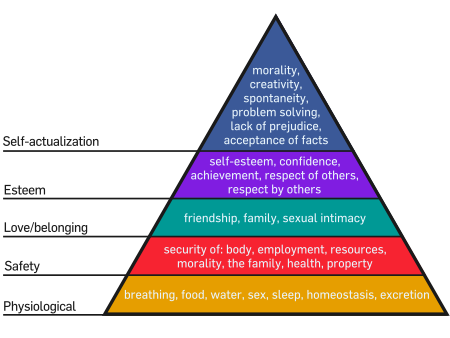
Maslow’s Hierarchy of needs is a useful concept to understand the priorities a human being has, it isn’t perfect and the order can be shuffled somewhat. I am going to examine the basic goals of government based on this concepts view. So what are the foundational goals (equivalent to Physiological and Safety) of governments? Before questions of morality or righteousness can be asked, what does a government have to do?

The modern ideologies that need to be discarded to properly answer this question are many, free-trade,
Neo-liberalism, libertarian, objectivism etc. All say that government regulation is always bad and we should rely on the private sector for almost everything. Given that history shows otherwise, how long have governments been around? Several thousand years at least and still going strong, I can safely say these ideologies are missing important details. This isn’t to say that all government regulations are good and the private sector is useless, Soviet Russia is an example of rampant regulation, only that both need to be used and understood.

A government’s first job is survival, of both itself and its people (after all, the government is normally a part of the people) and this goal is fulfilled in multiple ways. The obvious way is the sheer physical survival of its people and this task involves a few parts. The provisioning of food and water, then distributing it to the population is an iconic form of this. Many of the original governments formed around this goal, organising waterworks, actually distributing food, looking after the granaries, setting up a market system and building the transport infrastructure required. Waterworks could take generations to build and then required careful management, provided by the local government (or bigger if part of a kingdom). The failure of governments to satisfy a society’s need for food and water is normally, and rightly so, greeted by social unrest, in the form of bread riots, rebellion etc.

Basic law and order is also another important role and to illustrate this I will use the Fayu, a New Guinean tribe, as an example. The Fayu used to number 2000 but reduced their populations to 400 within 1 generation due to revenge killings, using sharpened stakes and stone knives. Once a population reaches a certain density some form of conflict resolution is required and while other social structures (religion is one) can fulfil this role, to an extent, at any point Australia will be at a government will be needed for this. Justice can be carried out by any governmental form, from a council of elders to an invested judge.

Another aspect of survival is that of the group and its identity, this is important because government is an abstract concept, a system and a group of people. As a social construct its survival is directly linked to a societies cohesion and mental framework, destroy this and any government will cease to exist (the lose of legitimacy is the common form). This manifests in many ways and is normally tied to other social forms; state religion, controlled press, national identities etc.

These form the primary task of any government, the maintenance of internal survival.

The next step up is maintaining security (from other groups) and maintaining/improving infrastructure. Organising; defences, militia, armies, supply/communication lines etc is the main way to fulfil the first of these goals. The infrastructure part comes in many forms; roads, bridges, electricity grids, ports, railways, bureaucracy, hospitals etc and this is what allows economic integration and centralisation to occur, modern corporations are completely dependent on such infrastructure. This level isn’t strictly necessary but is required for the higher levels to be achieved.

These considerations are the first that must be asked to decide if a government is defective, before moral and ethical values are examined. The most brutal tyrannical government that fulfils these goals is better that the freest democracy that doesn’t (let alone the fact that the democracy would be quickly overrun by the tyranny in this case). Current governments cannot, especially in the face of collapse, just coast on their prestige of being democratic while ignoring these concerns. Doing so only imperils democracy and threatens either a collapse into feudalism (like the dark ages) or a rise in tyranny (another round of Hitlers and Mussolinis)

This process of governments failing in their basic duties has happened before; the rise of Hitler and his compatriots was no accident and helped by the political failure of his day. The current economic and political crisis’s are currently on the path for a repeat of this pattern as the current governments refuse to implement the solutions necessary (such as a default and rebuilding of their economies for the transition and Overshoot).

These basic levels of governance in the context of transition need to be figured out well before the question of democracy, morality or any of the other questions that are commonly asked of governments can be contemplated. The government systems that will survive overshoot and flourish after it need not be democratic or just, it is preferable but not necessary. If we wish for these types of governments to survive the basic support structures on which they rest must be secured or they will wither and fade away until a new form of government replaces them. 

Tuesday, 6 November 2012

Biofuels


Biofuels are one of the many approaches being tried to solve peak oil, all the word means is fuels derived from organic matter (organic in this case means from living things, generally plants). To explain why we’re trying I have just pulled out a paragraph from my chemistry textbook from the chapter on biofuels (it’s a small chapter and they’ve just added it recently). I find it surprisingly honest about what’s happening for its source
   
Peak oil
‘Peak oil’ is the time when worldwide oil extraction can no longer keep up
with increasing demand.
The greatest amount of oil discovered in any one year was in 1964,
and since then the new reserves found have gone down in size each year.
Meanwhile demand for oil has increased as the world population has
increased and lifestyle expectations have risen. The actual timing of ‘peak
oil’ is debatable. We may be there now!
The situation provides motivation to devise renewable and sustainable
sources of the carbon compounds, both for fuels and to provide feedstock
for the organic chemical industry.

The statement above is mostly accurate but many of the realities of biofuels are ignored and need to be stated here.  It uses agriculture that generates chemical energy as a fuel rather than as food, it suffers from the limits and faults of any agricultural system used to produce them and will change along with the rest of the agricultural system. It also competes with food production, which limits the production levels. While alternatives to using food are available, most of them suffer drawbacks and would still require nutrient cycling to remain sustainable.

Now the dominant form of agriculture is the industrial from, which suffers from an acute case of unsustainability. So, any biofuels produced under the current model also suffers from a case of unsustainability. Of more concern is the fact that the current agriculture system uses vast quantities of fuel energy and so any biofuel production would first have to compensate for its own production. Since the fuel use of industrial agriculture is so high this means that most biofuels produced today have a low or nil EROEI. High EROEI biofuels are produced mostly by hand labour (e.g. ethanol from Brazil) and can reach about 10. This means that replacing current farming practices with the various organics modes before introducing major biofuel production is the better option, since the supporting system is figured out first and it can then be decided if it is worthwhile.

 Biofuels also can’t replace petroleum and other fossil fuels in both amounts and usage. This doesn’t make them worthless, just that their role will be highly limited and needs to be supported with other energy sources.

So what are the biofuels?

Solids: The oldest biofuels, traditionally wood, normally used for fire & cooking, there are currently efforts to increase the range of sources of solid biomass available for heat energy. Charcoal is a refined form of wood and was used extensively in metalworking and glassworks. It’s actually superior to coke but costs more and its increased use caused large scale deforestation across large areas in Europe and America. Any organic material can be used as a feedstock for the new types being invented and as long as proper nutrient cycling takes place long-term soil fertility won’t suffer. Raw biomass does create large amounts of pollution however, which limits desirability.          

While it will not easily power motor vehicles (except electric or trains), it can easily supply heat in stationary operations or electrical/mechanical power production. Due to its difficulty to transport (relative to liquid fuels), the main constraint on use will be its availability in the immediate area and rural areas should have the greatest access while cities will probably use it as a small supplementary energy source at best. For military use, mostly cooking, supplementary heat and a local source of electricity.

Biogas: The chemical of interest in biogas is methane, which is identical to natural gas. This allows the use of existing infrastructure of natural gas to be directly used with only 1-2 components added. The production of biogas, anaerobic digestion of biomass, has two products; a solid known as digestate, which can be used either as a fertilizer or as fuel (fertilizer will be the default option) and a mixture or methane, hydrogen, hydrogen sulphide (corrosive) and carbon monoxide gases. This is one of the easier biofuel production processes and is relatively simple and cheap (the Chinese are engaged in massive biogas programs). 

When upgraded (takes 3-6% of the energy in the gas to upgrade) it can power machinery without corroding it, hydrogen sulphide isn’t a very nice chemical. Compression into a liquid can allow easy use in vehicles and has been shown to be able to power trains (Sweden), this also makes it a candidate for military use. Like all biofuels, rural areas will have the greatest access but thanks to its ability to be transported easily by pipes a connection to the rural hinterland could allow a reasonable supply to cities; this also counts for the liquid biofuels.  

Fuel cells offer a highly efficient way of converting methane directly into electricity as opposed to using hydrogen.

Ethanol: otherwise known as alcohol and is made by yeast fermenting sugars anaerobically. Comes in a liquid form, which makes it directly usable in combustion engines; either as an additive or (in Brazil) as the fuel, some engines do need modifications through (it can melt plastics). By-products of production can be used a animal feed (high in protein) or fertilizer but carbon dioxide is also produced. Improvements, like GM bacteria that can use waste products or special breakdown process of plant cellulose, are happening and could help keep basic (limited) motorized transport running. Would most likely be produced in abundance by Queensland’s sugar cane crop, similar to Brazil’s approach. 

Isn’t as good on the engine as gasoline is, but it can be used for fire quite well. E.g. http://www.ozflame.com.au/. Most likely, it won’t be used as the primary combustion fuel (biodiesels are better for that) but it can be used as a solvent, as an antiseptic, chemical feedstock and as a drink.

 Biodiesel: Is produced by the breakdown of triglycerides by Tran esterification (breaks a lipid into 3 fatty acids and a glycerol). Energy density is close (about 9% lower) to petrodiesel but it does offer a higher cetane rating (combustion quality) and better lubricating qualities which helps offset its disadvantages.

Due to the higher energy densities and increased efficiencies of diesel, biodiesels use in heavy machinery, armoured fighting vehicles and ships is likely, if biofuels are used for the military it will most likely be the primary fuel used. Can also power aircraft and in rural areas would provide heavy muscle to add to the other energy sources available. As a sidenote, from the crushing of oil seeds a high protein and carbohydrate meal residue is produced which can be feed to livestock, this makes it more attractive for farms to produce the Biodiesel for themselves.  

Usage Levels and Nutrient Cycling: Two important questions remain about biofuels, how do they fit in the energy mix we’ll have during the transition and ecotechnic phases and how the nutrients used will be cycled back into the soil.

To understand how nutrient cycling will work I’ll list the elements of the fuels and where they come from. For ethanol the nutrient used is glucose which is made of Carbon, Hydrogen and Oxygen, all the fuels contain only this elements (if the fuel is pure) and Charcoal is only Carbon while biogas is Carbon and Hydrogen. In sugar production water is split in the chloroplasts by light (artificial photosynthesis is an attempt to copy this process) to form Hydrogen and Oxygen. The Carbon comes from the Carbon dioxide in the atmosphere around the plant and is used to form the backbone to which Hydrogen and Oxygen is attached. Therefore, as long as only the fuel is leaving the farm or local area the plants via the atmosphere can replace the nutrients. Of course, the soil normally gains these nutrients when the plants die and taking them away will make the soil poorer than it would otherwise be. The principal loses are organic carbon and a source of energy (that is what sugar is after all) for the soil organisms and in some way this needs to be compensated, leaving the land fallow could work and there are undoubtedly other approaches suited to each area, biochar could certainly compensate for the lowering of organic carbon levels.

The usage of biofuels will depend on the traits of other energy sources as much as its own traits. Given that wind and solar suffer from intermittency while biofuels can be used whenever you want (after production) then a compensatory role is likely. This also fits with their ease of storage relative to wind and solar, similar to granaries but for energy instead of food. Balancing the amount of food storage with energy storage (since it can be converted only one-way) will be tricky and a vital decision of any society that seeks to employ biofuels.

For storage, a good system could involve two levels. The first level could be considered the day to day use (or in this case year-to-year) and is for individual farmers and towns to supplement other energy sources. This would carry over from month to month and partially from year to year and provides the main usage for everyday life. The second level is made from the surplus from the first storage level and is used for the bigger regional/national energy expenditures. While the first level is used for yearly famines the second can be used for multi-year famines, in effect they allow no biofuels to be produced that year without losing energy, that the first level couldn’t cover. This second level would cover major infrastructure expansions/maintenance and such, major wars, festivals and other big energy expenditures.

Using them in this fashion also has another advantage, large amounts aren’t required. Since it is only acting as a backup energy source, the wind and sun will always be around, instead of a primary energy source the levels needed in stocks only need to be about a month or 2 supply and extra can be produced as needed. Since biofuel production above a certain level (above what waste can provide) will bite into food supplies the ability to only have a small amount is useful.

Sunday, 28 October 2012

Guest post: What the post peak navies could look like


 The last of my twins posts in the naval series.

Often naval ages get named after their primary method of propulsion. The naval age after the Transition could well be called either the Hybrid age or the new age of sail. Warships would most likely have two propulsion methods, similar to those of the SS Savannah. The primary method would be sail used for strategic long distance movement, while the secondary system would be some form of biofuel engine , most likely gas or diesel, for inshore, tactical movement, fast movement and possibly to generate electricity as well. Of these two Gas turbines are probably the more likely choice, biogas has a far simpler production process than biodiesel and Gas turbines are highly effective at fixed high speeds, as well as being already in use for combined systems with diesel to take advantage of this. This efficiency at high speed, the potential to generate electricity from the gas turbines and the simplified fuel production are all advantages, however storage and energy density could be the deciding factor in favor of biodiesel. Biodiesel has far greater energy density than biogas meaning that more energy could be stored on similar sized ships and storage systems.

Several factors in naval war that are no longer present or severely diminished would most likely return. Two of them are fueling stations and armor. Fuelling stations are likely to return as a way to reliably resupply warships with biofuel, allowing their rapid redeployment without exhausting their fuel or against the dominant wind currents and as a way to maintain large stocks of biofuel allowing greater amounts to be accessible when needed than otherwise could be found and allowing ships to fight outside of harvest seasons. The biofuel would likely be produced in small amounts during peacetime and stockpiled for when it’s needed. Armor will likely return as the destructive potential of the weapons decreases allowing it to become effective again, though potentially only as partial armor. The amount of armor used on a warship would have many potentials as there are several variables now added due to the post peak world, in short while more armor gives a ship more survivability it also increases the energy use of the vessel, possibly lowering the acceptable amount of armor significantly below its possible size and coverage.

The naval period that the post peak navies will resemble most would most likely be either the age of Steam and Ironclads, the Big Gun era or WWII Carriers. The reason for this is that cannon technology and explosive shells would almost certainly be viable precluding the use of wooden ships for warfare (commerce is another thing) as explosive shells can easily and rapidly destroy wooden ships. This means that the ships would either have wooden hulls but metal armor (ironclad) or be made out of metal entirely (or other hard materials such as ferrocement). With the addition of turrets if the requisite metal working is possible this would translate into the big gun era and the return of WWI style battleships, or due to the smaller production capabilities, cruisers. Aircraft may however remain viable in a large way and something similar to WWII and modern style navies centered around fleet carriers could remain or return (after the transition), however in a highly altered form.

If the ironclad era returns then the result would be difficult to predict and would depend on the exact technologies that survive. If guns regress to a certain stage, losing much of their penetration capability but heavy armor returns it could lead to extreme difficulty in damaging ships with cannon fire, then the statement by Sir John Colomb “The ram was now the ultimate weapon” (1867) would be accurate but late by several hundred years. Alternatively armor could be of minimal use leading to Monitors (small and slow with large guns) becoming prevalent. Alternatively turrets and large scale metal working could remain and this could lead to a new Big gun era, of fully metal and armored warships with the size of the ship and guns being the primary feature of warships. These and other alternatives exist, especially when other technologies such as torpedoes are considered.

Aircraft, if they remain, are likely to combine both heavier and lighter than air versions. Lighter than air would likely look similar to the Aeromodeller II and could be for cargo and long range scouting. If heavier than air remains it will almost certainly be non jet engine and thus much slower than modern planes and likely with shorter operational range. These aircraft will have several advantages over warships, mainly their height. This height could allow for the use of low powered and low tech missiles to hit surface targets at great range, whereas surface targets couldn’t respond in kind due to the energy requirements of a surface to air missile’s (High density) and the cost required to make guidance systems. Due to fuel constraints however the missiles may not be able to carry sufficient loads to damage warships unless their range is reduced, potentially bring the aircraft in range of reprisal or alternatively the missiles could be slow enough that it is possible to destroy them with AA fire. They would also have smaller payloads and so traditional bombers and dive bombers could return. This could lead to a slightly fluid environment where aircraft could be significant threats to warships but not consistently enough to rely on. Heavier than air aircraft also have the downside of requiring significant amounts of fuel to fly and so would have limited range outside of home territory and only limited capability of projecting them through carriers and island bases. They would also have limited operation times due to limited amounts of fuel, leading to similar problems as seen by Germany during WWII in regards to operations, especially during the later stages of the war, could become common.

Making solid predictions on the potential fate of submarines is made difficult by their complexity. The concept and use of submersibles is old and goes before the wide scale use of fossil fuels, the first military submersible being the Turtle in the American civil war. Their potential use in deep waters and even significantly far from friendly ports however relies on their ability to access a significant amount of technologies and fuel, these technologies include the ability to balance the submarine, maintain pressure and air tightness etc. This could render the submarine a minor part of post peak fleets mainly used to attack known shipping lanes if it remains viable. However subs would have great potential in closed waters (such as the Strait of Malacca or the Mediterranean) especially if the technologies required to combat subs (sonar) is lost or unavailable in the post peak world. Where subs could especially shine could be in their potential as minelayers, especially to lay mines in hostile waters.

Mines will likely become far more common in the post-peak world than they are today. This stems from the fact that they are the most cost effective naval weapons ever invented. With mines costing hundreds of dollars sinking million dollar warships during both world wars, including multiple battleships, and their effectiveness shown during the Russo-Japanese war, the Dardanelles campaign, and Operation Starvation (mining Japanese waters from air). One of the greatest uses of mines is as sea denial weapons; this use has gone back as far as 1855 where a planned British attack on Kronstadt (a very important Russian naval base) was cancelled upon the sighting of mines. The use of mines to deny sea control is effective, even against modern fleets, with a planned naval assault on Wonsan during the Korean War was postponed when two minesweepers were sunk. This caused Rear Admiral Allen E to state, “We have lost control of the seas to a nation without a navy, using pre-World War I weapons, laid by vessels that were utilized at the time of the birth of Christ.” Mines have also sunk the most US warships in the post war period, potentially making them the most effective and cost effective naval weapon in current existence.

One aspect that will shape the post peak naval world regardless of its form is the radical reduction in manufacturing capability and general production ability in the post peak world when compared to any of these ages. This would lead to vastly smaller navies than have historically been fielded as well as different fleet compositions, with higher small to big ship ratios. Construction times for ships would also increase quite drastically, causing naval conflicts to be even more ‘come as you are’ than normal, as even the smaller combatants would take years to build and large ships decades. This would have several other affects, naval tactics and strategies would likely become conservative, in the sense of being cautious, to avoid losing ships irreplaceable over the course of most conflicts. Ship design would also change with a focus on cheap maintenance, long lasting ship hulls, and the use of crew over manufactured items where possible. The first change could likely see indecisive battles similar to the Battle of Jutland become the norm for large scale naval battles. The reduction in manufacturing capability and hence ability to maintain long supply lines and fleets on far distant shores, the ability to recuperate major losses and (potential) removal of major technology gradients could limit the reach of naval empires or make their conquests fleeting and tenuous. Support ships, carrying fuel, ammo and spare parts will likely have minor roles in the post peak world. With limited resources to build and maintain ships they could easily be an unaffordable luxury for many fleets, especially given that ships would not use fuel for long distance movement and would likely stay close to ports. This limited amount of support ships would probably be reflected in warship design, with most warships able to carry significant supplies of food, fuel, ammo and spare parts.
Support ships would still be useful for certain operations, particularly piracy and blockades, potentially they could even be critical for said operations as they would allow ships to stay on station or patrol for longer times, potentially allowing these operations to be carried out by the far smaller fleets.

Monday, 22 October 2012

Why this focus on globalness ?


There are many levels that responses to overshoot can take place at; global, interstate, national, regional, local and individual levels. While all levels are engaged, in some way, there seems to be gaps in the current responses. After reading quite a few essays and books (like Fleeing Vesuvius), I noticed that after the national level discussion jumps immediately to the global (or sometimes the continental level) and misses an important level: co-operation among a small group of bordering or otherwise related states. After all states are quite powerful and can still take action, even against strong corporate or imperialistic pressures, such as the IMF, UN or other IGGs. At the time of writing Syria is defending itself from the U.S.A‘s imperialism, and their local allies, the Arab Emirates, while foreign fighters are flooding the country. Closer to home, the Australian government passed both the carbon and mining tax against corporate influence (Gina Rinehart, at the time the worlds richest women, was against both of them). Events like these are far from rare, Putin fought against oil magnates backed by the west successfully and in the process countered assertions that corporations would take control of governments. States are still among the strongest actors on the world stage despite the wishes of corporations or activists.

In his essay on sailing (in Fleeing Vesuvius) Dimitri Orlov mentions that in groups above 12, politicking takes place. In any of the global initiative’s, the majority of nations would need to be involved, a number well above 12. If we think of a state as roughly one individual then it makes more sense for states to organise in small units (like ANZUS) rather than a large global unit. There are already movements towards this, such as the possible Nordic Alliance, and if activists/proponents ignore this in favour of only global or local (both end points of a spectrum) solutions, a powerful tool for adaptation is missed. After all, in a deglobalising world your neighbours matter more, this counts for states as much as for people.

Of course, there are large differences between states and individuals and these needs to be taken into account. First, since each nation is in fact a group of people and the negotiations would be done by a select group as opposed to 1 person, the total should be lowered to around 6 and smaller groups of 2-4 should be preferred. Second, since the group, as a whole, co-ordinating can have less complex thoughts overall and interactions than an individual more focus is needed. While on the sailing ship, the 12 people can do all the jobs and co-ordinate everything on a ship needed for survival, since a state is already self-sufficient the pacts needs to be of a more focused area. If these modifications are taken into account, successful state pacts can be made.

How do these relationships work and what goals could they have? The obvious and most common are military alliances and defence pacts, but there are other forms, such as free trade areas. In the future barter relationships between states exporting strategic goods (oil, rare earths, food, etc) and importers of strategic goods will become more common and these could easily mesh with military alliances. On a note closer to a response to overshoot states could form sustainability pacts, renewable science exchanges, shared climate disaster relief programs and various steady state economic pacts.

Heres a couple of ideas for Australia
·         A pact to encourage commercial sailing ships between Australia and/or New Zealand, Indonesia and New Guinea. This would be a regional attempt to change our current maritime system into a more sustainable one and keep oceanic trade going through the collapse. Would involve research, incentives, infrastructure building (docks, ports, knowledge base etc) and policies to encourage private industry to shift to a sail based trading system between the signing nations. This could then spin-off to developing hybrid sailing/biofuel ships for either naval or commercial use.

·         Renewable energy technology/technical skills exchange with an oil-exporting nation. Since oil-exporting nations generally have rising energy use, which lowers oil exports, it makes sense for us to lower their oil use by fostering the use of local renewable energy instead, this would likely be an oil-exporting nation we have a barter relationship with. If it weren’t for current international politics (which can shift rapidly), Iran would be a perfect candidate for this, we exchange uranium (one of their goals in their nuclear projects is to lower oil use) for oil and then use this platform to engage with their renewable programs. This allows us a greater access to oil (nuclear power is a long-term project) and an increased renewables tech base, Iran has some of the best researchers (indicated by their success in reverse-engineering ships and drones) in the world and they have specifically said they would push for renewables to lower internal oil use.

·         A regional defence pact. This could have one of two goals; either deterring the imperial ambitions of whatever state tries to replace the US’s empire in the region or as a stability and anti-piracy action. By pooling the military might of the local region, each nation has to pay less overall to stop piracy or shore raiders wrecking maritime trade and sttlement, an important goal of any coastal/island nation. It can also help to stop the imperialism of superpowers because what matters in the end is local superiority, if the imperial power can’t gain local superiority then they can’t win in that region. Similar to the five power defence arrangement (minus Britain). After all, Napoleon was only stopped from creating a French empire by his enemies continually uniting against him.  

 These sorts of pacts won’t save industrial civilisation, but then nothing can so they shouldn’t be judged by that criteria. What they can instead do is help nations, and thus the individuals inside those nations, adapt to overshoot and get more of our heritage through the coming Dark Age than would otherwise get through. It’s certainly more likely to work than big global attempts which commonly dissolve into infighting or simple finger pointing, such as Copenhagen or the Kyoto Protocol.

Monday, 15 October 2012

Guest Post: Preparing For a Transition navy


The Transition will cause great problems and difficulties for the Australian Navy however; these difficulties can be mitigated somewhat by preparation. This preparation would have to be in many ways psychological as well as physical. This preparation would also likely, due to current circumstances, have to take part at least partly during the early stages of the collapse. Such preparations could only happen if Australia begins feeling the affects of the collapse after most other nations begin to be affected
                
A very important preparation would be accepting the fact that their will be very harsh limits on how many ships can be fielded and how much wealth can be spent on the navy and hence what it can accomplish. Failure to acknowledge these limits could cause massive strategic missteps. Today such missteps, such as this British one on Afghan Infrastructure, do not generally cause major damage or problems. However, in a world of very limited and declining resources such as Transition, any misstep has the potential to cause massive and irrevocable damage. The damage could range from massive loss of economic activity due to the withdrawal of wealth to maintain too large a fleet, to having most of our fleet unable to function due to a lack of maintenance.
Coupled with the accepting of limits is the discussion of what the navy will attempt to accomplish out of all that it could try to accomplish. This means that the navy’s goals must be clearly laid out, as well as having sustained discourse on the possible ways to achieve these goals and which ones are more important than the others are. Needed as well is the ability not to attempt things when we are already at the limits of our capabilities.

Another form of preparation would be working out the fundamentals of Transition in military terms of capabilities and complexity, discussed in the ADF journal article Lasers or Longbows? A Paradox of Military Technology. This means keeping as high a level of capability as possible while simultaneously reducing complexity. For the Navy this will be even more important and difficult, due to the inherently high complexity of warships, than for other branches. This could be done through small-scale experimentation of simplifying warship equipment before resources get scarce, allowing for more avenues of research to be explored. And if some successful methods are found soon enough, changing the existing equipment on current warships before the Transition begins.
            Tying in with this would be figuring out how to retrofit beforehand, what ships would be suitable for retrofitting, what roles they could fulfill, and what problems will be encountered when attempting to do so.

Other forms of preparation would also be maintaining both a general industrial base as well as specific industries, despite globalization and cheap labor in China and loss of energy. This along with becoming more self sufficient in military hardware would help reduce complexity (through reduction in supply line length) as well as reduce vulnerability to foreign instability. These could all be done through government policy and of defense force procurement strategies focused on local production. The basic industrial capacity would primarily be based on maintaining metalworking, especially steel, and at least a small level of electronics or computing (possibly mechanical, like the original battleships). The specific industries would be shipbuilding, limited levels of chemical production and high precision engineering. The location of these industries in Australia would also increase our ability to retool said industries for the Transition; more quickly refit/retrofit our ships. This would also prevent our navy being held hostage to other nation’s circumstances such as a civil war destroying their ability to export to us vital equipment or from seizing our equipment in their docks.

Connecting deeply with the local region now, before the collapse starts affecting our relations, on as many levels as possible is a vital step, one that is already being taken due to the belief in the ‘Asian century’ as well as our increasing economic ties to the region. This would focus particularly on our neighboring island nations such as Indonesia, New Caledonia, and New Zealand (already very close). This could involve anything from sending more students to these countries, increasing our diplomatic efforts to those countries, and creating military ties and treaties with those nations. These ties would be critical as those island nations in geographical terms form a shield protecting our valuable east coast and to a lesser extent the north coast. These islands would only serve to defend Australia if they were not hostile to us, if they were hostile, an invasion from an imperial power becomes possible, or even from the island nations. Other important reasons include their closeness to us and the potential for important and prosperous trade between us. These ties will become strained once the Transition begins but if they are, close enough they can remain unbroken and allow us to cooperate with them both during and after the Transition.

Much of the preparation that can be done for Transition includes psychologically preparing for the realities of Transition on a national scale, this however will have limited effectiveness unless it also includes a sustained discussion on how to respond as well as concrete physical steps to prepare for the Transition. Problems for preparing for Post-collapse stem from the closeness of the beginning of the collapse, or even that it has already begun by certain measures limiting the amount of preparation time available and the resources accessible to do so.

Saturday, 6 October 2012

Will the Asian century matter?


With the economic rise of China, India and smaller southeastern Asian countries (such as the 4 Asian tigers), the 21st century is expected by many to be the Asian century. However, with Overshoot about to bite down and forced relocalisation to begin, will this actually matter for Australia? As international trade/transport declines, what will it matter if Asia’s economy (or only parts) is booming? As local industries that are integrated into local markets that have re-emerged and imports/exports decline in importance, what does it matter if some other economy is growing? As the decentralising effects of renewables changes the structure of our economy, how will the centralisation model of superpowers work?

While I doubt that the Asian century will happen as predicted due to Overshoot, lets imagine it does. So let us see what some of the possible factors to the answer for the question above are.

As international transport capacity falls, it will not matter how much Asia produces since a bottleneck has been formed (without even taking into account lack of resource shipments to Asia).  Now international transport capacity is not functionally limited and the limiting factors are in other sectors of the economy. But peak oil will change that by lowering utility (via slower speeds, less ships and more expensive transport) of the current system and hampering the ability of creating a new one. The direct adaptation is relocalisation. For Australia and New Zealand, this effect will be even more pronounced due to our isolation. Asia will become more relatively important since they are closer, while their absolute importance declines, so at the beginning it could matter but as transport continues to decline it will eventually decline with it.

Relocalisation will directly challenge globalisation, which the Asian century is based upon by removing mass imports/exports. This will involve the direct revival of local manufacturing in Australia to use our abundant local resources and to fulfil local needs. Thanks to peak oil, the rise of rise of renewably powered industry is assured and the shift in structure it brings. These industries are, however, limited when compared to modern industries and won’t have the productive power of the industries in Asia, luckily that won’t matter as much since they aren’t exporting industries.

Renewable energy is, relative to non-renewables, inherently decentralised and drives industry to be located over a large area instead of being concentrated in small areas. The reason for this is quite simple, renewable energy is available over large areas, and is acutely vulnerable to concentration losses. While non-renewables come in a concentrated form and, barring uranium, easy to transport. Since our economy will downscale anyway, having many small manufactories instead of one or two big factories would work fine. This reduces reliance on Asia for manufactured goods. While the imports remain they will be increasingly restricted to either capital goods and the rich until everything of importance is made locally.

So does the Asian century matter to us?

Monday, 1 October 2012

Guest post: generalised naval strategies for a transition Navy


This is the second in my twin’s naval posts (once a fortnight)

For the Transition, our main maritime goals will be the protection of nearby trade routes and the securing of our territorial integrity, especially in the North (roughly Townsville to Broome). The challenges to achieving both of these goals will be great, as our ability to meet them will be degraded from the disruptions of the post peak world as well as the increasing difficulty of meeting those goals.

The increased difficulties in achieving these aims come from the increased affects of population pressure and failing economies and states. The main way piracy has been combated in modern times is through economic prosperity and state building. Economic stability and state building works in two ways, increasing the amount of legitimate and safe ways to earn a living and hence making piracy unattractive, it also increasing the ability and motive of the local government to deal with piracy by shutting them out of ports or taxing them heavily as they can now wield the power needed to do so, as well as motive through the taxing of trade through the ports, an activity that is threatened by pirates. With the reversal of economic fortunes, a Somalia like situation could become increasingly likely in numerous locations as governments and economies weaken or even become pirate states. This would mean that the main piracy problems would likely come from or centered on weakened or failed states. The other sources of piracy would be privateers or state backed pirates but they primarily have political causes and solutions.

The problems from population pressures would follow from the decrease in food production worldwide, creating overpopulation problems rapidly. This would threaten our territorial integrity as an invasion could begin to look like an attractive solution (especially for Indonesia with almost 250 million people) primarily of the sparsely populated north. Population pressures could also lead to mass migrations; changing significantly the demographic make ups of parts of Australia, probably only in the North. This threatens our territorial integrity as the North could quite easily become non-Australian and secede from the rest of the country permanently. The ruggedness of the terrain would prevent or slow down any movements south but would also make any reversal of the situation unlikely. This would cause permanent problems, especially if the seceding territory is under the control of Indonesia or some other nation, even if the seceding territory is limited to the coast. It would limit our ability to project force North for Anti-piracy operations through the loss of strategic ports (Darwin) into the Asia-Pacific as well as representing a potential threat to our trade routes into Asia.

The Navy required to combat these challenges would need to be both cheap, numerous and able to operate away from our shores. This would mean small warships (frigates and destroyers). These ships would primarily patrol and sweep trade routes for pirates as well as escort cargo ships in order to reduce and combat piracy. Their task would be crucial in order to stop the threat of piracy spreading as piracy could easily create a positive feedback loop where piracy reduces the economic health of a region (from pirates in said region) leading to an increase or appearance of piracy in that region, causing the problem to get worse and spread geographically. Cruisers would potentially be needed if pirate kingdoms or sultanates form and the turreted cannon returns as the main ship weapon. They would be needed due to the increased firepower and armor needed to destroy the pirate ships and fortifications. They would however be much more expensive than the smaller ships and so few, if any would be built.

The responses to the threat of Invasion and/or mass migration are more complex. The threat of mass migration has multiple possible responses ranging from the heavily isolationist response of turning back or sinking the boats to the multiculturalists’ approach of integrating the migrants into our society. All of these solutions would require ships and could be handled by the ships designed for anti-piracy operations and easily and cheaply supplemented by small patrol ships. Their roles could vary from the sinking of vessels to the detection and escorting of boats to proper ports to prevent illegal/undocumented migrants. The threat of invasion makes any response critical as certain changes in the demographics of the North could make invasion both easier and more attractive. While Australia has complete control over the North the threat of invasion can be countered with a strong naval presence. Mass migration threatens this as an invader could have significant local support, even %10 of the population supporting an invader would be a serious problem. Thus an important way to deal with the threat of an invader would be to deal with mass migration. The ability to fight or deter an invasion would still be important as a successful invasion could easily open the way for mass migration (if none was present before), permanently changing the demographics of the North. To do this would require the ability to keep some form of naval presence in the Timor, Arafura and the Coral seas despite a potentially larger enemy fleet. One way this could be done is through the fortifying of Darwin and small ports and coastal towns along the North such as Weipa and port Douglas, both against naval and land assaults, as well as connecting those places through railroad to the rest of Australia. This would allow us to supply the North, potentially cut or disrupt enemy armies form supply or even stop the invasion outright through deterrence or power. Adding to the ability to disrupt and/or deter an invasion could be through a small force of subs as well as strong/strategic allies such as Papua New Guinea and China.

One major problem in the anti-piracy operations and the strategy for dealing with mass migration is the sheer size of the areas we would be dealing with. This limits the effectiveness of anti-piracy patrols as the pirates could more easily hide as well as attack shipping unhindered. It would also make any migrant boats harder to detect before they land on our shores and disrupting whatever strategies we are using to deal with mass migration. One way to deal with this would be to build a massive amount of ships but this would be expensive and likely unfeasible. One way to get around this would be the use of airplanes for reconnaissance, World War I & II prop planes rather than modern jets due to fuel and cost considerations. These could operate from land bases, dedicated carrier ships or even modified warships. If Carrier’s are used they will be closer to the escort carriers of WWII and Australia’s previous carriers previous carries, with fewer aircraft and smaller size than modern fleet carriers. They would most likely be converted commercial ships which is what many escort carriers were. Another option would be adding limited launch capability to the warships, as was done for the HMAS Australia, this would give the navy limited aerial reconnaissance capabilities at a reduced cost compared to dedicated carriers. All of this would take significant capital to start and maintain, so depending on the intricacies of the transition they may not be feasible.

One of the larger problems with dealing with these threats is that of feedback. As the economic situation worsens, all of the threats will become larger as piracy increases and population problems become worse, causing the situation to become even worse. This would also limit our ability to deal with the problems as it would reduce our ability to support and maintain a significant navy. This could easily spark of a self reinforcing loop ending in disaster unless it can be checked. This means that one of the key strategies to dealing with these problems would be to limit the economic devastation of transition in the countries of the Asia-Pacific; this can not be solely done through a naval response. There would also be sharp limits in our ability to slow the economic devastation and it would take enormous political will to attempt anything sufficient when our economy also starts feeling that devastation.