Tuesday, 11 December 2012

The Decline Of global Imperialism


The Spanish empire started the trend of their being only 1 or 2 global empires that dominated the world stage. Great Britain was at the zenith of this trend when it directly ruled 20% of the world’s landmass and controlled the majority of world trade; this trend (and Britain) has been on the decline since. In the wake of Britain’s soft collapse the USA and the USSR fought, during the cold war, to claim Britain’s lost position of dominance for themselves, the USSR fell and so the USA gained status as the world’s sole superpower, and the end of the USA dominance is now approaching. In the wake of its decline and collapse, new world orders will appear, most likely after the competing powers have sorted themselves out through the standard imperial sorting method of war, strategic positioning and international politics. In a continuation of the current trend, another (or two) global empire/s would arise, the main contenders currently including China and a now resurgent Russia. However, with the process of overshoot entering the decline phase, this assumption needs to be questioned and alternatives examined. The decline of global transport and communication infrastructure will hamper force projection, whether it’s economic, militarily, cultural or political projection. Relocalisation of industry will strengthen local powers at the expense of imperial ones, the technology gradient that has existed since the days of Spain when European armies could outfight any locals using superior weapons, training and tactics has diminished greatly and military tactics/technology has changed in favour of the defender as opposed to the attacker. See the 2006 Lebanon war where Hezbollah used defences to negate the Israeli armour and airforce. How can a global hegemony function in these conditions? What imperial structures can exist and thrive under the stress this change brings? I propose a potential model based on the BRICS (Brazil, Russia, India, China, and South Africa) nations with a potential, though unlikely, continental European empire.

This system would mark a dramatic shift in the way major powers relate to one another and act in the world. Under the current system, each empire (or group of empires) has only one major opponent at any time and everyone coalesced around one of the contenders. Think of the Axis and Allies or the Triple Entente and the Triple Alliance. This new system is more like the constantly warring Greek city states or Renaissance Italy, with multiple powerful factions unable to permanently dominate, note this system can and has changed into a similar form of what we have now e.g. the Peloponnesian war or France and Spain entering Italy, Machiavelli mentions this in the Prince. For each major power, there are now multiple major enemies at any time and they are restricted how far they can act against any other power, major and minor, before their ability to respond to other powers is compromised. This creates a highly complex playing field where even minor powers can have significant effects on the grand scheme. To accommodate these changes Australia’s foreign policy and actions on the world stage would have to adapt. I’m assuming the Federation will remain for mainland Australia, however this isn’t a certainty and it would further complicate things if the federation dissolves.

Gearing for a more independent role and more ties with the other regional powers around us, rather than choosing America or China as imperial powers (yes, China is a regional power but the relationship is very different) and worrying about global problems or areas far away, like Iraq or Afghanistan, is the sensible path forward. Since the global empire/s would have less control overall than the USA or Britain did and we live in a peripheral part of the world (less than the days of Britain but still peripheral), we and our neighbours will now have an opportunity to write our own history (bloody as it may be) independent from powerful outsiders. Moving our military focus towards our navy (but in a non-expeditionary way) as opposed to our current focus on our army and expeditionary forces (see the Canberra Class), we’d still have an army, just a modified form, would be among the first steps since Australia and all our neighbours are islands, instead of simply allying with the next rising power, instead becoming a fully independent actor with which an imperial power entering our region must entreat, and deal with. Using our strategic position, isolation and superior local forces we could wring a few concessions out of them and via the support of local resistance (guerrilla or otherwise) we could drain the forces of any imperial power that decides to enter our region against our will. This path will require us to take more responsibilities and a far more active approach in our region; alternatively, we could become highly isolationist.

So what could relations among the BRICS’s empires look like? An important detail is their respective strengths in light of their locations and different strengths and weaknesses. Russia and China are likely to be the strongest of the five empires, for historical, economic and military reasons, however Brazil and South Africa are on their own continents and so they will mainly act with the others in colonial or local sphere of influence events, as well as being distant from RIC, where their powers have a home advantage. India is in a more interesting situation since it sits on the opposite side of China compared to Russia and is in a very good position to cut of China’s sea routes to Africa and Europe, especially the Malacca strait, which India has looked into. While on its own, China could easily overpower or bully India into submission, Russia could be very interested in an alliance to contain China. These sorts of power plays would be quite common, the more empires there are, the more common, and complex they become. This is where Australia could affect the world stage in a substantial way, leveraging our strengths for or against one side, acting as a lynchpin of some plan or other or even as deal breakers or makers.

Wednesday, 5 December 2012

What is a city?


Cities are one of the main ways humans inhabit the landscape and organise themselves, though they have only recently, historically speaking (Data), become where most people live. They, historically, made up for their lack of population with concentration and by being major economic, cultural and political centres. While climate potentially change the locations of our major cities, possibly further inland, I think its more than likely that our current cities will exist during and shortly after overshoot. After all Sydney was founded by convicts with no access to fossil fuels and only indirect assistance from them (in the form of the British Empire). Therefore, if cities will play a role in overshoot the obvious question must be answered.

What is a city?

To aid the answer here is an appropriate extract from Terry Pratchet’s Night watch

    Everyday, maybe a hundred cows died for Ankh-Morpork. So did a flock of sheep and a herd of pigs and the gods alone knew how many ducks, chicken and geese. Flour? He’d heard it was eighty tons, and about the same amount of potatoes and maybe twenty tons of herring. He didn’t particularly want to know this kind of thing, but once you started having to sort out the everlasting traffic problems these were the facts that got handed to you.
   Everyday forty thousand eggs were laid for the city. every day, hundreds, thousands of carts and boats and barges converged on the city with fish and honey and oysters and olives and eels and lobsters. And to think of the horses dragging this stuff, and the windmills… and the wool coming in, too, everyday, the cloth, the tobacco, the spices, the ore, the timber, the cheese, the coal, the fat, the tallow, the hay EVERY DAMN DAY….
And that was now. Back home, the city was twice as big….
   Against the dark screen of night, Vimes had a vision of Ankh-Morpork. It wasn’t a city, it was a process, a weight on the world that distorted the land for hundreds of miles around. People who’d never see it in their whole life nevertheless spent their life working for it. Thousands and thousands of green acres were part of it, forests were part of it. It drew in and consumed….
…and it gave back the dung from its pens and the soot from its chimneys, and steel, and saucepans, and all the tools by which its food was made. And also clothes, and fashions and ideas and interesting vices, songs and knowledge and something which, if looked at in the right life, was called civilization. That’s what civilization meant. It meant the city. 

So we can see that a city is also a process as much as a place and includes the immediate area it gains resources from and its products go to, e.g. in the past ¾ of some cities were metal works. From the hinterland come the raw (and sometimes refined) resources, such as wheat, eggs, ore and timber, that a city consumes and out it gives the refined products (like steel, weapons and tools), culture and now days machines/equipment. What can form from this is a symbiotic relationship that enhances both the city and rural communities. 

Here’s an example; a village machine shop maybe able to produce almost all the villages needs but lacks the skills, resources and time to make some of its own high precision equipment. Now instead of cutting other services to be able to remake this equipment or losing whatever capability the equipment provides. The machine shop could instead import the equipment from a city, which has far more machine shops, engineering works and the like. The village machine shop could then maintain the equipment without sacrificing capabilities and allow the village to produce more using the machine shops products. This can feed back into greater exports to the city and hence the overall economic activity and technological complexity. This form of symbiotic relationship will be important if we wish to keep a relatively high level of technology/technical skills.

The level of technology is quite important when thinking about sustainability on this scale as the smallest unit shifts as the tech level increases. While at most levels the village is the most basic unit as the tech level rises it becomes the village- town relationship and then the village-town-city complex. If we want an eco-technic future, we need more than eco-villages, at a minium we need eco-towns as well and then eco-cities. This is not to say that village level sustainability isn’t worthwhile, since villages can more easily downshift tech level, simply that to have an eco-technic future, rather than a medieval future, the cities that exist today will need to be involved.

Sunday, 25 November 2012

How Will the World’s population die?


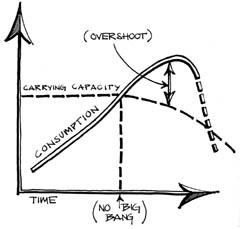
Of all the major trends, overshoot will bring , one of the most important is how the global human population will shrink to a sustainable level. this is assured as current population levels well exceed the Earth’s carrying capacity with only renewable resources available. The basic graph looks like this.

For us humans the declining carrying capacity has two parts;

Loss of non-renewables: Fossil fuels belong to this category, anything that requires them to access and ores deep in the ground, the main industrial materials in this category (recycling is a different matter). For agriculture the main loss is the relatively stable climate, other losses include fossil aquifers or deposits of Phosphates and other nutrients. Once this section of carrying capacity is lost it won’t be regenerated over anything but geological timeframes.

Loss of renewables: Soil fertility, fisheries and forests are the most common; this includes elements that can renew themselves over time,normally biological systems. However, once depleted many of these elements stop regenerating, examples  include the collapse of the North Atlantic Cod fishery and the deforestation by the Anasazi of Chaco valley (Collapse by Jared Diamond). Action can be taken to create renewable resources; reforestation, recycling of metals (renewal of stocks), building soil fertility, silviculture etc.

While the ultimate carrying capacity is variable and will fluctuate over time due to climate, ecological and cultural variables (consumption levels), it will be well below current population levels.

The important question now becomes how the world’s human population will decline. On a global scale this is likely to follow a smooth curve down, shown on the graph above, however what we care about for Australia is the local/regional of us and the Asia-Pacific change. Here’s an example of the differences between global (or continental in this case) and local.  2011 was for the US an average year in terms of rainfall over the entire nation, but when each state was looked at separately what was found was that more extremes had happened. Simply put there were more floods and droughts but when the entire nation was analysed they cancelled each other out.

As such there are two ends of the spectrum of population collapse; fast or slow. Dimitri Orlov describes the slow process in his book Reinventing Collapse as a changing in the birth/death ratio so a population exponentially decays (say 2-4%). This is a fairly peaceful and stable way for population to decline, if we have a choice we should aim for this. The fast way includes (and makes other fast collapse more likely) mass migration, plagues, wars, famines or other disasters. These can quickly change population levels and in the process cause great discord and chaos. We should try to avoid these events. The worst action we could take is to maintain current population levels as this just prolongs the collapse.
While the general trend will be decline, areas will experience population growth. The northern coast of Australia will likely see a boom as desperate refugees (climate, war or other) migrate there. This would then be followed by a crash as the lack of agricultural potential causes famines; the graph to the right shows such a process with reindeer. Some areas will keep a stable population; New Zealand is a good candidate for that., while Indonesia (among many others) is set for a dramatic reduction in population.

A note on time frames: if we use 300 years as a benchmark for the the massive population growth which is now going to be reversed, the decline will probably take 200-300 years overall and places will alternate between fast, slow collapse and points of stability (or even growth).

Population changes it will have dramatic effects on our economic, political and military systems. Anticipating and preparing could negate unnecessary misery and ease the many transitions we face

While its a bit late for any drastic changes to the outline, basic preparations could still help. Most of the standard response to overshoot (summed up as a mixture of using less resources and switching to more sustainable production/agriculture modes). Other options include slowing, then stopping, major international food trading while making food importers more self-sufficent, using organic agriculture or massive agricultural research into agriculture in third world countries.

Monday, 19 November 2012

Time Scale of Collapse


In discussions of collapse, specifically if it will be a fast collapse or a slow decline of our current civilisation, what can be forgotten is that slow or fast are relative terms and change from varying viewpoints.

Heres a Terry Pratchett extract (Reaper Man) to illustrate

              ‘A city is alive. Supposing you were, a great slow giant, like a counting pine, and looked down at a city? You’d see buildings grow; you’d see attackers driven off; you’d see fires put out. You’d see the city was alive but you wouldn’t see people, because they’d move to fast.’

What looks fast to the counting pine above looks slow to us and what looks slow to it is a lifetime for us. Civilisations operate on such a timescale. If the collapse takes 3/5 the time it took for industrial civilisation to rise (300 years) then collapse would be 180 years – several lifetimes. What’s fast for a civilisation is still a slow process for us humans.

Then there’s all the other processes, trends and civilisations happening at the same time. After all Industrial civilisation was born within previous civilisations and people can live partly in multiple civilisations. The figure above for the life of Industrial civilisation (300 years) is wrong in an important sense; according to Lewis Munford’s Technics and Civilisation it was actually born in the early middle ages, which puts it at about 1000 years old. The last 300 years marks the time when it became the dominate part of civilisation and began impacting larger and larger segments of society. From this we can confidently say that an ecotechnic civilisation has already been born, possibly from the time of Augustine Mouchot (French pioneer of solar cooking and engines)  possibly earlier, and is slowly gaining the strength and pieces it needs. same with all the other civilisations that are forming in the twilight of Industrial civilisation.

As people and societies, slowly or quickly, drop out of Industrial civilisation they will enter into another; salvage, ecotechnic, herder, agrarian, nomadic, sailing or one of the many possible cultural civilisations around. This can be in steps or piece by piece e.g. A craftsmen who works salvage using charcoal to trade for industrial goods, the urban organic farmer living in an industrial city and other such halfway points.

This could easily mask the broad decline of Industrial civilisation and hide its eventual death. The driver for all these changes is overshoot as it weakens the dominate civilisation and allows new ones to compete in what has become an intensely Darwinian environment.

Sunday, 11 November 2012

What is the Role of Governments?


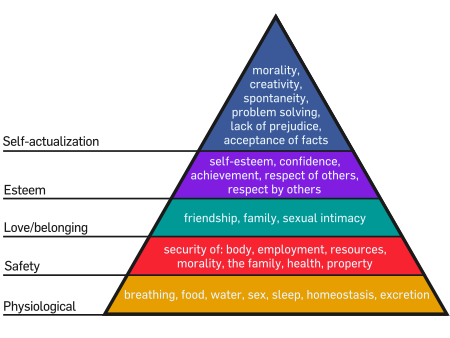
Maslow’s Hierarchy of needs is a useful concept to understand the priorities a human being has, it isn’t perfect and the order can be shuffled somewhat. I am going to examine the basic goals of government based on this concepts view. So what are the foundational goals (equivalent to Physiological and Safety) of governments? Before questions of morality or righteousness can be asked, what does a government have to do?

The modern ideologies that need to be discarded to properly answer this question are many, free-trade,
Neo-liberalism, libertarian, objectivism etc. All say that government regulation is always bad and we should rely on the private sector for almost everything. Given that history shows otherwise, how long have governments been around? Several thousand years at least and still going strong, I can safely say these ideologies are missing important details. This isn’t to say that all government regulations are good and the private sector is useless, Soviet Russia is an example of rampant regulation, only that both need to be used and understood.

A government’s first job is survival, of both itself and its people (after all, the government is normally a part of the people) and this goal is fulfilled in multiple ways. The obvious way is the sheer physical survival of its people and this task involves a few parts. The provisioning of food and water, then distributing it to the population is an iconic form of this. Many of the original governments formed around this goal, organising waterworks, actually distributing food, looking after the granaries, setting up a market system and building the transport infrastructure required. Waterworks could take generations to build and then required careful management, provided by the local government (or bigger if part of a kingdom). The failure of governments to satisfy a society’s need for food and water is normally, and rightly so, greeted by social unrest, in the form of bread riots, rebellion etc.

Basic law and order is also another important role and to illustrate this I will use the Fayu, a New Guinean tribe, as an example. The Fayu used to number 2000 but reduced their populations to 400 within 1 generation due to revenge killings, using sharpened stakes and stone knives. Once a population reaches a certain density some form of conflict resolution is required and while other social structures (religion is one) can fulfil this role, to an extent, at any point Australia will be at a government will be needed for this. Justice can be carried out by any governmental form, from a council of elders to an invested judge.

Another aspect of survival is that of the group and its identity, this is important because government is an abstract concept, a system and a group of people. As a social construct its survival is directly linked to a societies cohesion and mental framework, destroy this and any government will cease to exist (the lose of legitimacy is the common form). This manifests in many ways and is normally tied to other social forms; state religion, controlled press, national identities etc.

These form the primary task of any government, the maintenance of internal survival.

The next step up is maintaining security (from other groups) and maintaining/improving infrastructure. Organising; defences, militia, armies, supply/communication lines etc is the main way to fulfil the first of these goals. The infrastructure part comes in many forms; roads, bridges, electricity grids, ports, railways, bureaucracy, hospitals etc and this is what allows economic integration and centralisation to occur, modern corporations are completely dependent on such infrastructure. This level isn’t strictly necessary but is required for the higher levels to be achieved.

These considerations are the first that must be asked to decide if a government is defective, before moral and ethical values are examined. The most brutal tyrannical government that fulfils these goals is better that the freest democracy that doesn’t (let alone the fact that the democracy would be quickly overrun by the tyranny in this case). Current governments cannot, especially in the face of collapse, just coast on their prestige of being democratic while ignoring these concerns. Doing so only imperils democracy and threatens either a collapse into feudalism (like the dark ages) or a rise in tyranny (another round of Hitlers and Mussolinis)

This process of governments failing in their basic duties has happened before; the rise of Hitler and his compatriots was no accident and helped by the political failure of his day. The current economic and political crisis’s are currently on the path for a repeat of this pattern as the current governments refuse to implement the solutions necessary (such as a default and rebuilding of their economies for the transition and Overshoot).

These basic levels of governance in the context of transition need to be figured out well before the question of democracy, morality or any of the other questions that are commonly asked of governments can be contemplated. The government systems that will survive overshoot and flourish after it need not be democratic or just, it is preferable but not necessary. If we wish for these types of governments to survive the basic support structures on which they rest must be secured or they will wither and fade away until a new form of government replaces them. 

Tuesday, 6 November 2012

Biofuels


Biofuels are one of the many approaches being tried to solve peak oil, all the word means is fuels derived from organic matter (organic in this case means from living things, generally plants). To explain why we’re trying I have just pulled out a paragraph from my chemistry textbook from the chapter on biofuels (it’s a small chapter and they’ve just added it recently). I find it surprisingly honest about what’s happening for its source
   
Peak oil
‘Peak oil’ is the time when worldwide oil extraction can no longer keep up
with increasing demand.
The greatest amount of oil discovered in any one year was in 1964,
and since then the new reserves found have gone down in size each year.
Meanwhile demand for oil has increased as the world population has
increased and lifestyle expectations have risen. The actual timing of ‘peak
oil’ is debatable. We may be there now!
The situation provides motivation to devise renewable and sustainable
sources of the carbon compounds, both for fuels and to provide feedstock
for the organic chemical industry.

The statement above is mostly accurate but many of the realities of biofuels are ignored and need to be stated here.  It uses agriculture that generates chemical energy as a fuel rather than as food, it suffers from the limits and faults of any agricultural system used to produce them and will change along with the rest of the agricultural system. It also competes with food production, which limits the production levels. While alternatives to using food are available, most of them suffer drawbacks and would still require nutrient cycling to remain sustainable.

Now the dominant form of agriculture is the industrial from, which suffers from an acute case of unsustainability. So, any biofuels produced under the current model also suffers from a case of unsustainability. Of more concern is the fact that the current agriculture system uses vast quantities of fuel energy and so any biofuel production would first have to compensate for its own production. Since the fuel use of industrial agriculture is so high this means that most biofuels produced today have a low or nil EROEI. High EROEI biofuels are produced mostly by hand labour (e.g. ethanol from Brazil) and can reach about 10. This means that replacing current farming practices with the various organics modes before introducing major biofuel production is the better option, since the supporting system is figured out first and it can then be decided if it is worthwhile.

 Biofuels also can’t replace petroleum and other fossil fuels in both amounts and usage. This doesn’t make them worthless, just that their role will be highly limited and needs to be supported with other energy sources.

So what are the biofuels?

Solids: The oldest biofuels, traditionally wood, normally used for fire & cooking, there are currently efforts to increase the range of sources of solid biomass available for heat energy. Charcoal is a refined form of wood and was used extensively in metalworking and glassworks. It’s actually superior to coke but costs more and its increased use caused large scale deforestation across large areas in Europe and America. Any organic material can be used as a feedstock for the new types being invented and as long as proper nutrient cycling takes place long-term soil fertility won’t suffer. Raw biomass does create large amounts of pollution however, which limits desirability.          

While it will not easily power motor vehicles (except electric or trains), it can easily supply heat in stationary operations or electrical/mechanical power production. Due to its difficulty to transport (relative to liquid fuels), the main constraint on use will be its availability in the immediate area and rural areas should have the greatest access while cities will probably use it as a small supplementary energy source at best. For military use, mostly cooking, supplementary heat and a local source of electricity.

Biogas: The chemical of interest in biogas is methane, which is identical to natural gas. This allows the use of existing infrastructure of natural gas to be directly used with only 1-2 components added. The production of biogas, anaerobic digestion of biomass, has two products; a solid known as digestate, which can be used either as a fertilizer or as fuel (fertilizer will be the default option) and a mixture or methane, hydrogen, hydrogen sulphide (corrosive) and carbon monoxide gases. This is one of the easier biofuel production processes and is relatively simple and cheap (the Chinese are engaged in massive biogas programs). 

When upgraded (takes 3-6% of the energy in the gas to upgrade) it can power machinery without corroding it, hydrogen sulphide isn’t a very nice chemical. Compression into a liquid can allow easy use in vehicles and has been shown to be able to power trains (Sweden), this also makes it a candidate for military use. Like all biofuels, rural areas will have the greatest access but thanks to its ability to be transported easily by pipes a connection to the rural hinterland could allow a reasonable supply to cities; this also counts for the liquid biofuels.  

Fuel cells offer a highly efficient way of converting methane directly into electricity as opposed to using hydrogen.

Ethanol: otherwise known as alcohol and is made by yeast fermenting sugars anaerobically. Comes in a liquid form, which makes it directly usable in combustion engines; either as an additive or (in Brazil) as the fuel, some engines do need modifications through (it can melt plastics). By-products of production can be used a animal feed (high in protein) or fertilizer but carbon dioxide is also produced. Improvements, like GM bacteria that can use waste products or special breakdown process of plant cellulose, are happening and could help keep basic (limited) motorized transport running. Would most likely be produced in abundance by Queensland’s sugar cane crop, similar to Brazil’s approach. 

Isn’t as good on the engine as gasoline is, but it can be used for fire quite well. E.g. http://www.ozflame.com.au/. Most likely, it won’t be used as the primary combustion fuel (biodiesels are better for that) but it can be used as a solvent, as an antiseptic, chemical feedstock and as a drink.

 Biodiesel: Is produced by the breakdown of triglycerides by Tran esterification (breaks a lipid into 3 fatty acids and a glycerol). Energy density is close (about 9% lower) to petrodiesel but it does offer a higher cetane rating (combustion quality) and better lubricating qualities which helps offset its disadvantages.

Due to the higher energy densities and increased efficiencies of diesel, biodiesels use in heavy machinery, armoured fighting vehicles and ships is likely, if biofuels are used for the military it will most likely be the primary fuel used. Can also power aircraft and in rural areas would provide heavy muscle to add to the other energy sources available. As a sidenote, from the crushing of oil seeds a high protein and carbohydrate meal residue is produced which can be feed to livestock, this makes it more attractive for farms to produce the Biodiesel for themselves.  

Usage Levels and Nutrient Cycling: Two important questions remain about biofuels, how do they fit in the energy mix we’ll have during the transition and ecotechnic phases and how the nutrients used will be cycled back into the soil.

To understand how nutrient cycling will work I’ll list the elements of the fuels and where they come from. For ethanol the nutrient used is glucose which is made of Carbon, Hydrogen and Oxygen, all the fuels contain only this elements (if the fuel is pure) and Charcoal is only Carbon while biogas is Carbon and Hydrogen. In sugar production water is split in the chloroplasts by light (artificial photosynthesis is an attempt to copy this process) to form Hydrogen and Oxygen. The Carbon comes from the Carbon dioxide in the atmosphere around the plant and is used to form the backbone to which Hydrogen and Oxygen is attached. Therefore, as long as only the fuel is leaving the farm or local area the plants via the atmosphere can replace the nutrients. Of course, the soil normally gains these nutrients when the plants die and taking them away will make the soil poorer than it would otherwise be. The principal loses are organic carbon and a source of energy (that is what sugar is after all) for the soil organisms and in some way this needs to be compensated, leaving the land fallow could work and there are undoubtedly other approaches suited to each area, biochar could certainly compensate for the lowering of organic carbon levels.

The usage of biofuels will depend on the traits of other energy sources as much as its own traits. Given that wind and solar suffer from intermittency while biofuels can be used whenever you want (after production) then a compensatory role is likely. This also fits with their ease of storage relative to wind and solar, similar to granaries but for energy instead of food. Balancing the amount of food storage with energy storage (since it can be converted only one-way) will be tricky and a vital decision of any society that seeks to employ biofuels.

For storage, a good system could involve two levels. The first level could be considered the day to day use (or in this case year-to-year) and is for individual farmers and towns to supplement other energy sources. This would carry over from month to month and partially from year to year and provides the main usage for everyday life. The second level is made from the surplus from the first storage level and is used for the bigger regional/national energy expenditures. While the first level is used for yearly famines the second can be used for multi-year famines, in effect they allow no biofuels to be produced that year without losing energy, that the first level couldn’t cover. This second level would cover major infrastructure expansions/maintenance and such, major wars, festivals and other big energy expenditures.

Using them in this fashion also has another advantage, large amounts aren’t required. Since it is only acting as a backup energy source, the wind and sun will always be around, instead of a primary energy source the levels needed in stocks only need to be about a month or 2 supply and extra can be produced as needed. Since biofuel production above a certain level (above what waste can provide) will bite into food supplies the ability to only have a small amount is useful.

Sunday, 28 October 2012

Guest post: What the post peak navies could look like


 The last of my twins posts in the naval series.

Often naval ages get named after their primary method of propulsion. The naval age after the Transition could well be called either the Hybrid age or the new age of sail. Warships would most likely have two propulsion methods, similar to those of the SS Savannah. The primary method would be sail used for strategic long distance movement, while the secondary system would be some form of biofuel engine , most likely gas or diesel, for inshore, tactical movement, fast movement and possibly to generate electricity as well. Of these two Gas turbines are probably the more likely choice, biogas has a far simpler production process than biodiesel and Gas turbines are highly effective at fixed high speeds, as well as being already in use for combined systems with diesel to take advantage of this. This efficiency at high speed, the potential to generate electricity from the gas turbines and the simplified fuel production are all advantages, however storage and energy density could be the deciding factor in favor of biodiesel. Biodiesel has far greater energy density than biogas meaning that more energy could be stored on similar sized ships and storage systems.

Several factors in naval war that are no longer present or severely diminished would most likely return. Two of them are fueling stations and armor. Fuelling stations are likely to return as a way to reliably resupply warships with biofuel, allowing their rapid redeployment without exhausting their fuel or against the dominant wind currents and as a way to maintain large stocks of biofuel allowing greater amounts to be accessible when needed than otherwise could be found and allowing ships to fight outside of harvest seasons. The biofuel would likely be produced in small amounts during peacetime and stockpiled for when it’s needed. Armor will likely return as the destructive potential of the weapons decreases allowing it to become effective again, though potentially only as partial armor. The amount of armor used on a warship would have many potentials as there are several variables now added due to the post peak world, in short while more armor gives a ship more survivability it also increases the energy use of the vessel, possibly lowering the acceptable amount of armor significantly below its possible size and coverage.

The naval period that the post peak navies will resemble most would most likely be either the age of Steam and Ironclads, the Big Gun era or WWII Carriers. The reason for this is that cannon technology and explosive shells would almost certainly be viable precluding the use of wooden ships for warfare (commerce is another thing) as explosive shells can easily and rapidly destroy wooden ships. This means that the ships would either have wooden hulls but metal armor (ironclad) or be made out of metal entirely (or other hard materials such as ferrocement). With the addition of turrets if the requisite metal working is possible this would translate into the big gun era and the return of WWI style battleships, or due to the smaller production capabilities, cruisers. Aircraft may however remain viable in a large way and something similar to WWII and modern style navies centered around fleet carriers could remain or return (after the transition), however in a highly altered form.

If the ironclad era returns then the result would be difficult to predict and would depend on the exact technologies that survive. If guns regress to a certain stage, losing much of their penetration capability but heavy armor returns it could lead to extreme difficulty in damaging ships with cannon fire, then the statement by Sir John Colomb “The ram was now the ultimate weapon” (1867) would be accurate but late by several hundred years. Alternatively armor could be of minimal use leading to Monitors (small and slow with large guns) becoming prevalent. Alternatively turrets and large scale metal working could remain and this could lead to a new Big gun era, of fully metal and armored warships with the size of the ship and guns being the primary feature of warships. These and other alternatives exist, especially when other technologies such as torpedoes are considered.

Aircraft, if they remain, are likely to combine both heavier and lighter than air versions. Lighter than air would likely look similar to the Aeromodeller II and could be for cargo and long range scouting. If heavier than air remains it will almost certainly be non jet engine and thus much slower than modern planes and likely with shorter operational range. These aircraft will have several advantages over warships, mainly their height. This height could allow for the use of low powered and low tech missiles to hit surface targets at great range, whereas surface targets couldn’t respond in kind due to the energy requirements of a surface to air missile’s (High density) and the cost required to make guidance systems. Due to fuel constraints however the missiles may not be able to carry sufficient loads to damage warships unless their range is reduced, potentially bring the aircraft in range of reprisal or alternatively the missiles could be slow enough that it is possible to destroy them with AA fire. They would also have smaller payloads and so traditional bombers and dive bombers could return. This could lead to a slightly fluid environment where aircraft could be significant threats to warships but not consistently enough to rely on. Heavier than air aircraft also have the downside of requiring significant amounts of fuel to fly and so would have limited range outside of home territory and only limited capability of projecting them through carriers and island bases. They would also have limited operation times due to limited amounts of fuel, leading to similar problems as seen by Germany during WWII in regards to operations, especially during the later stages of the war, could become common.

Making solid predictions on the potential fate of submarines is made difficult by their complexity. The concept and use of submersibles is old and goes before the wide scale use of fossil fuels, the first military submersible being the Turtle in the American civil war. Their potential use in deep waters and even significantly far from friendly ports however relies on their ability to access a significant amount of technologies and fuel, these technologies include the ability to balance the submarine, maintain pressure and air tightness etc. This could render the submarine a minor part of post peak fleets mainly used to attack known shipping lanes if it remains viable. However subs would have great potential in closed waters (such as the Strait of Malacca or the Mediterranean) especially if the technologies required to combat subs (sonar) is lost or unavailable in the post peak world. Where subs could especially shine could be in their potential as minelayers, especially to lay mines in hostile waters.

Mines will likely become far more common in the post-peak world than they are today. This stems from the fact that they are the most cost effective naval weapons ever invented. With mines costing hundreds of dollars sinking million dollar warships during both world wars, including multiple battleships, and their effectiveness shown during the Russo-Japanese war, the Dardanelles campaign, and Operation Starvation (mining Japanese waters from air). One of the greatest uses of mines is as sea denial weapons; this use has gone back as far as 1855 where a planned British attack on Kronstadt (a very important Russian naval base) was cancelled upon the sighting of mines. The use of mines to deny sea control is effective, even against modern fleets, with a planned naval assault on Wonsan during the Korean War was postponed when two minesweepers were sunk. This caused Rear Admiral Allen E to state, “We have lost control of the seas to a nation without a navy, using pre-World War I weapons, laid by vessels that were utilized at the time of the birth of Christ.” Mines have also sunk the most US warships in the post war period, potentially making them the most effective and cost effective naval weapon in current existence.

One aspect that will shape the post peak naval world regardless of its form is the radical reduction in manufacturing capability and general production ability in the post peak world when compared to any of these ages. This would lead to vastly smaller navies than have historically been fielded as well as different fleet compositions, with higher small to big ship ratios. Construction times for ships would also increase quite drastically, causing naval conflicts to be even more ‘come as you are’ than normal, as even the smaller combatants would take years to build and large ships decades. This would have several other affects, naval tactics and strategies would likely become conservative, in the sense of being cautious, to avoid losing ships irreplaceable over the course of most conflicts. Ship design would also change with a focus on cheap maintenance, long lasting ship hulls, and the use of crew over manufactured items where possible. The first change could likely see indecisive battles similar to the Battle of Jutland become the norm for large scale naval battles. The reduction in manufacturing capability and hence ability to maintain long supply lines and fleets on far distant shores, the ability to recuperate major losses and (potential) removal of major technology gradients could limit the reach of naval empires or make their conquests fleeting and tenuous. Support ships, carrying fuel, ammo and spare parts will likely have minor roles in the post peak world. With limited resources to build and maintain ships they could easily be an unaffordable luxury for many fleets, especially given that ships would not use fuel for long distance movement and would likely stay close to ports. This limited amount of support ships would probably be reflected in warship design, with most warships able to carry significant supplies of food, fuel, ammo and spare parts.
Support ships would still be useful for certain operations, particularly piracy and blockades, potentially they could even be critical for said operations as they would allow ships to stay on station or patrol for longer times, potentially allowing these operations to be carried out by the far smaller fleets.